

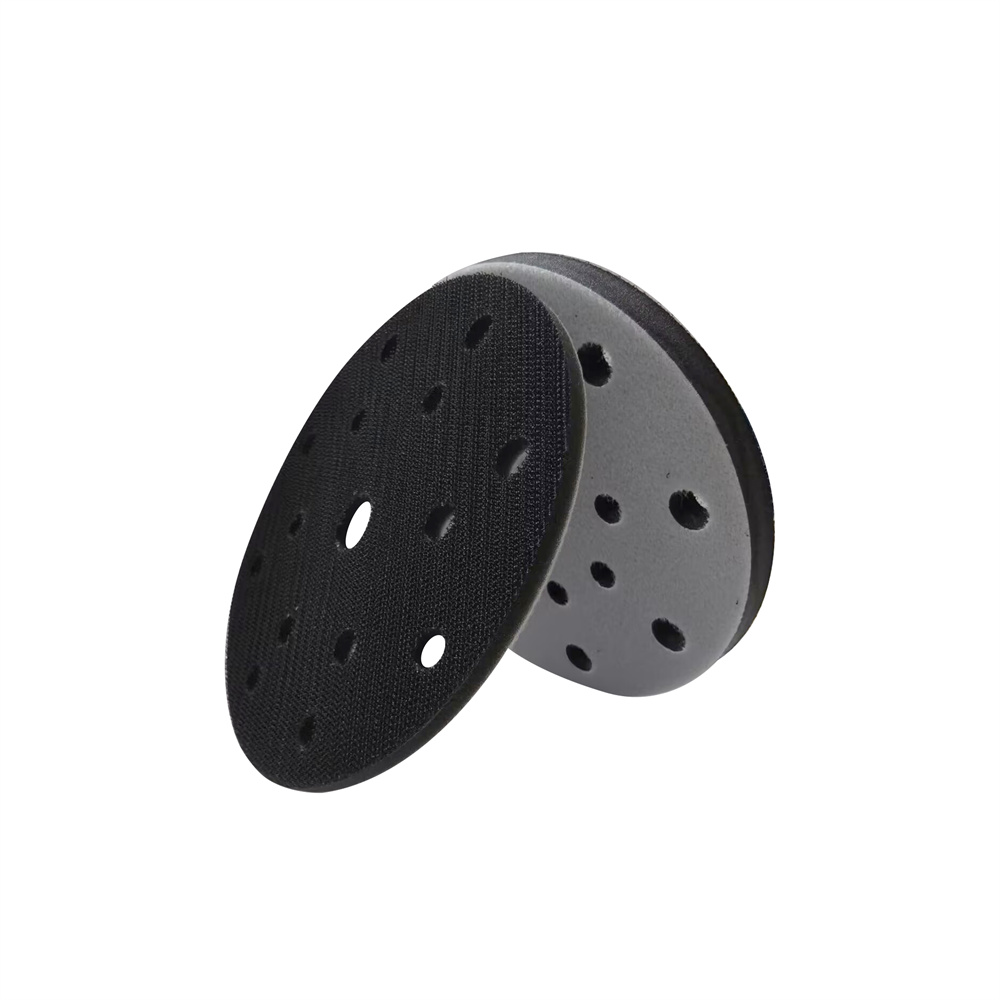
A backing pad is an essential power tool accessory mounted between sanding discs and sander bases. It provides buffered support for abrasive discs, ensures full surface contact, and delivers smooth, uniform sanding finishes. Often overlooked by DIY users and industrial contractors, a properly selected backing pad directly improves finishing quality, tool durability and job safety.
This guide covers the core benefits, common types, installation rules and key selection tips for backing pads to help you pick the right option for your sanding and polishing tasks.

Core Benefits of Backing Pads
Backing pads are indispensable for professional sanding, with 5 key advantages:
1. Better Contour Conformability
The foam buffer layer boosts sanding disc flexibility, letting abrasives fit curved edges and irregular workpieces perfectly. It avoids uneven sanding and jagged edge defects.
2. Lower Risk of Vibration-Related Injuries
Backing pads absorb sander vibration and mechanical shock, reducing risks of carpal tunnel syndrome and wrist fatigue during long-hour operation.
3. Even Pressure Distribution
It evenly disperses operating pressure across the whole disc surface, eliminating swirl marks, nicks and gouges—especially critical for soft wood, plastic and painted substrates.
4. Less Wear on Tools & Abrasives
The pad bears most friction instead of the sander base to extend tool service life. Built-in airflow channels discharge dust timely, prevent disc clogging and lower long-term consumable costs.
5. Higher Operational Control & Safety
Buffered support stabilizes sander operation on uneven surfaces, reduces machine jitter, and improves overall work precision and on-site safety.
Note: Working performance depends on matching pad style to your work material and application scenario.
10 Common Types of Backing Pads
Classified by mounting style, hardness and function, these are the most widely used backing pad categories:
1. Hook & Loop Pads (Most Popular): Universal loop-surface pads for fast disc replacement; premium models support dry and wet polishing.
2. Low-Profile Pads: Thick high-density foam design with moderate flexibility, optimized for fine surface finishing.
3. High-Performance Heavy-Duty Pads: Built for high-load industrial sanding, compatible with resin fiber and quick-change abrasive discs.
4. PSA Backing Pads: Pressure-sensitive adhesive pads for tool-free installation of self-stick sanding discs.
5. Spindle Mount Pads: Threaded shank design for small-diameter discs and detail rotary grinders.
6. Hand Sander Pads: Ergonomic soft foam pads with fixing straps for uniform manual sanding.
7. Palm Sander Pads: Contoured finger-groove pads designed for portable palm sanders.
8. No-Spin Pads: Free-floating structure to prevent over-grinding and damage on vertical or coated surfaces.
9. Zero-Burn Heat-Resistant Pads: Heat-control structure avoids tool overheating and workpiece burn marks for multi-directional sanding.
10. Custom Specialized Pads: Non-standard pads for niche equipment; on-site testing recommended for fit confirmation.
Pad Protectors: Definition & Differences
Pad protectors (pad savers) are thin auxiliary buffer sheets installed between backing pads and sanding discs. Different from standard backing pads, their core function is to protect backing pads from premature wear, strengthen disc adhesion and absorb residual vibration.
Not required for general light sanding, they greatly boost durability in heavy-duty continuous work and need regular replacement.
Installation & Maintenance Guide
Standard Installation Steps
Follow these universal safety steps for all sander and pad models:
1. Unplug the sander fully before replacing worn pads.
2. Follow official product assembly instructions.
3. Install all matched screws and locking hardware.
4. Tighten firmly with a wrench; confirm no shake before mounting sanding discs.
Replacement Cycle & Warning Signs
- Regular Cycle: Monthly replacement for daily heavy use; 3-6 months for occasional DIY use.
Replace pads immediately if you notice:
- Faded foam surface (internal material aging)
- Damaged hook loops or adhesive residue buildup
- Cracked, deformed or peeling pad edges
Quick Test: For hook-and-loop pads, cover 1/3 of the pad with a disc. If the disc stays fixed, the pad is still usable.
8 Key Factors to Select the Right Backing Pad
1. Size, RPM and Working Pressure
Match pad diameter exactly to your sanding disc size to avoid scratching or flying-off risks. Zhongyan Pad Max RPM Rating: 8" (10,000 RPM); 5/6" (12,000 RPM); 3" (13,000 RPM). Follow official specs for all Zhongyan pad products.
Choose thin pads for high-pressure grinding; thick flexible pads for low-pressure fine polishing.
2. Structural Design
Prioritize pads with heat dissipation and vacuum dust holes to prevent overheating and disc clogging; match hole layout with your abrasive discs.
3. Disc Mount Type
- Hook & Loop: Fast swapping, best for frequent disc replacement
- PSA Self-Adhesive: Simple stick-on installation for short batch tasks
4. Abrasive Disc Backing Compatibility
- Cloth-backed discs: Match medium-soft pads
- Paper-backed discs: Match firm high-support pads
- Fiber-backed discs: Match high-flexibility thick pads
5. Pad Thickness
- Thin Pads: Precision fine-grit finishing work
- Thick Pads: Heavily curved contour sanding
6. Sander Type
Select dedicated pads for your machine: Rotary, Orbital, Random Orbital (Dual-Action) and Detail Sanders. Original brand pads offer the best compatibility.
7. Pad Hardness
- Hard: Flat surface material removal, poor for contour work
- Medium: Factory default, ideal for most general tasks
- Soft: Curved/fragile surface polishing, better dust cleaning
8.Abrasive Material Matching
Match pad flexibility to your abrasives (Ceramic, Aluminum Oxide, Silicon Carbide, Garnet, Emery, Zirconia Alumina). Rigid abrasives pair with soft buffer pads for optimal cutting and heat dissipation.
interface sanding pad, interface pad for sanding, soft interface pad
Final Takeaways
Low-cost backing pads greatly impact sanding effect, tool lifespan and work safety. Select pads based on your sander type, workpiece shape, abrasive material and working pressure, and replace them on schedule to cut overall maintenance costs.
Explore full Zhongyan abrasive tools and matched premium backing pad collections for commercial and DIY sanding projects.